If you purchase an independently reviewed product or service through a link on our website, WWD may receive an affiliate commission.
The Complete 2026 Gap Beauty Perfume Collection
For anyone who spent their weekends browsing the mall in the ’90s, Gap Beauty’s fragrance collection may bring back a familiar memory: testing out scents at the beauty counter until you found your favorite.
Today, the brand is revisiting that era with the return of its iconic fragrance lineup. Originally launched in 1994, the collection’s recognizable scents — including Dream, Grass, Heaven, and Om — became part of the Gap identity before being discontinued in the early 2000s.
With recent collaborations and celebrity partnerships, including its viral Hailey Bieber denim drop, Gap has found renewed relevance among consumers. Some fashion and beauty watchers even believe the launch helped position the company for a beauty expansion by aligning it with Bieber’s growing influence in the category, thanks to her skin care line Rhode.
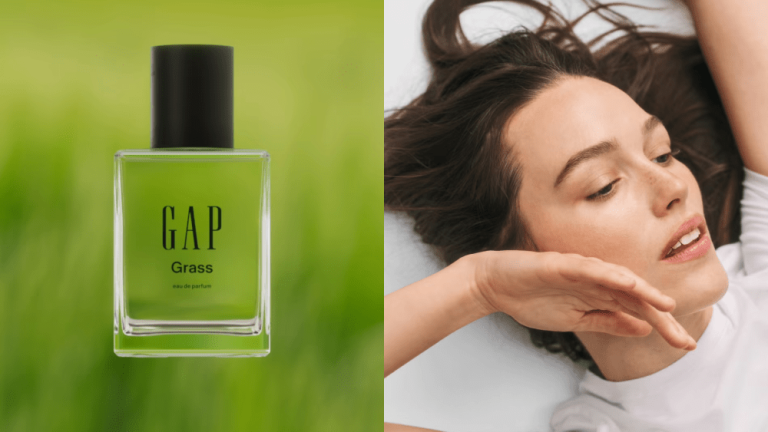
Gap Beauty has also tapped actress Victoria Pedretti to front its new “Wear What You Feel” campaign, underscoring a fresh approach to perfume while introducing the products to a new generation of shoppers.
For this project, Gap Beauty chose a route of reinterpretation rather than simple recreation. The new Dream stays close to the original with Italian bergamot, jasmine, and cedarwood. Grass, meanwhile, adds green mandarin and matcha to its 2.0 profile; Heaven features a softer blend of crisp pear, Madagascar vanilla, and amber; and Om puts forth a grounded concoction of ginger, sandalwood, and cedar.
The line is also marked by the arrival of Harmony, a never-before-seen fragrance boasting notes of apricot nectar, gardenia, and amber that can be worn alone or layered.
The formulas are available online in the form of eau de parfums, giving Gap Beauty’s nostalgic aromas a modern upgrade — and a second life beyond the mall.
Gap Dream Eau de Parfum
The fragrance you might remember from your first-ever mall shopping haul is back. Gap Beauty’s Dream Eau de Parfum stays true to its authentic spirit with Italian bergamot, jasmine, and cedarwood but also adds depth via a richer, more concentrated DNA designed to last longer on skin.
Price upon publish date of this article: $52

Gap Grass Eau de Parfum
Long before “fresh” became a perfume buzzword, Gap Grass had already perfected this scent family. It quickly became a mall-era must-have, courtesy of a clean, green profile that felt approachable and different from the heavier perfumes dominating the market at the time.
Gap Grass’ updated version, seen here, keeps all that signature vigor and purity with green mandarin, matcha, and Virginia cedar.
Price upon publish date of this article: $52

Gap Heaven Eau de Parfum
A trip down memory lane never smelled so good. Gap’s Heaven Eau de Parfum revives the beloved ’90s fragrance with a warm, inviting mixture of crisp pear, Madagascar vanilla, and amber — living up to every bit of its name.
Price upon publish date of this article: $52

Gap Om Eau de Parfum
While Dream and Grass captured the lighter side of Gap Beauty’s 1990s scent roster, Om provided something a little more down-to-earth. Its present-day manifestation merges ginger, sandalwood, and cedar for a calming, understated final result: no chanting necessary.
Price upon publish date of this article: $52

Gap Harmony Eau de Parfum
Meet the latest offering in Gap’s perfume portfolio. Harmony melts apricot nectar, gardenia, and amber into a playful fusion that’s meant to be personalized. Hint: Wear it alone or in conversation with Dream, Grass, Heaven, or Om.
Price upon publish date of this article: $52
Sign up for WWD Shop‘s newsletter to get the scoop on the best in beauty and style with in-depth reviews of exciting new releases and buyer’s guides to find the products you need to try ASAP.
Why Trust WWD
Since 1910, WWD — often referred to as “the fashion bible” — has been the leading industry voice of authority for senior executives in the global women’s and men’s fashion, retail and beauty communities, while also informing the consumer media that cover the market. Today, WWD’s breaking news and trend coverage continues to be a trustworthy resource for both fashion insiders and consumers alike. Our shopping editors continue to uphold WWD’s editorial standards and values with quality, expert-backed product selections. Learn more about us here.
About the Author
Camila Quimper is a Commerce Writer at Penske Media, where she covers fashion, beauty, luxury shopping, and the latest trends across WWD, Footwear News, Billboard, The Hollywood Reporter, and Rolling Stone. Previously, Quimper was a Commerce Editor at E! News, and her work has also appeared in Cosmopolitan, ELLE, Esquire, Men’s Health, i-D, Dazed, and other publications. Before joining E! News, Quimper got her start in e-commerce at Hearst Magazines, testing products alongside the Good Housekeeping Institute team, covering major shopping events, and curating gift guides. She earned a bachelor’s degree in fashion journalism from London College of Fashion, University of the Arts London and loves reporting on the best beauty finds to add to cart.
PakarPBN
A Private Blog Network (PBN) is a collection of websites that are controlled by a single individual or organization and used primarily to build backlinks to a “money site” in order to influence its ranking in search engines such as Google. The core idea behind a PBN is based on the importance of backlinks in Google’s ranking algorithm. Since Google views backlinks as signals of authority and trust, some website owners attempt to artificially create these signals through a controlled network of sites.
In a typical PBN setup, the owner acquires expired or aged domains that already have existing authority, backlinks, and history. These domains are rebuilt with new content and hosted separately, often using different IP addresses, hosting providers, themes, and ownership details to make them appear unrelated. Within the content published on these sites, links are strategically placed that point to the main website the owner wants to rank higher. By doing this, the owner attempts to pass link equity (also known as “link juice”) from the PBN sites to the target website.
The purpose of a PBN is to give the impression that the target website is naturally earning links from multiple independent sources. If done effectively, this can temporarily improve keyword rankings, increase organic visibility, and drive more traffic from search results.
