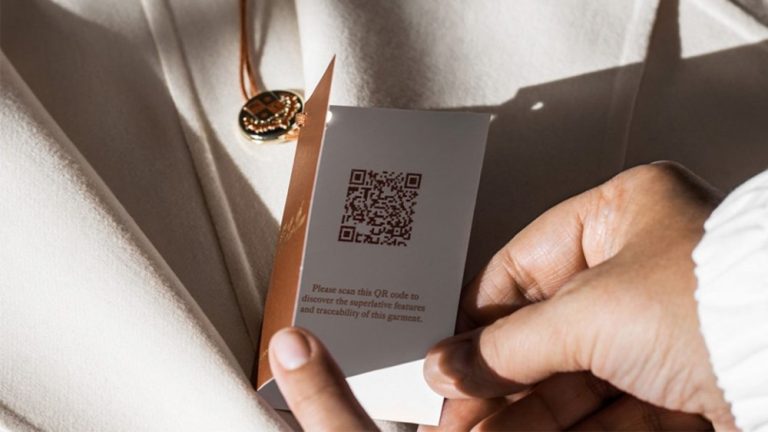
PARIS — Aura Consortium is expanding its digital product passport capabilities through a strategic partnership with French supply chain traceability platform Fairly Made, bringing environmental impact data into its blockchain-based product identification platform as the luxury industry readies for new EU regulations.
By joining forces, Fairly Made’s supply-chain mapping and environmental impact data will be matched to relevant products and displayed directly in Aura’s DPP product.
Consumers will then be able to access information including product composition, raw material origins, manufacturing processes and environmental impact by scanning an NFC chip or QR code linked to an individual product.
The deal comes as newly appointed chief executive officer Marcel Härtlein, a former Lalique executive who took the reins in January, is working to move Aura beyond its origins as a blockchain platform and grow it into an infrastructure and service provider for the luxury industry.
“Traceability is the foundation for a more transparent and accountable future for luxury. By connecting a product’s origins, journey and environmental impact, we can help brands turn information into lasting trust,” he said. “Our partnership with Fairly Made demonstrates how this traceability can enrich the customer experience by making information clear and accessible for consumers, while providing brands with a solution that is simple to integrate.”
Speaking to WWD earlier this year, he described the next phase of the consortium’s development as a move toward becoming a “value-creating industry orchestrator,” helping its members scale adoption of traceability and transparency technologies across their businesses.
Aura was founded in 2021 by LVMH Moët Hennessy Louis Vuitton, OTB, Prada Group and Richemont. It now counts more than 50 luxury brands and has registered more than 80 million products on its blockchain. Härtlein, who succeeded Romain Carrere as CEO, is working alongside newly appointed chairman Stefano Rosso, who took over the role from Prada’s Lorenzo Bertelli.
One of the main challenges facing brands as they prepare for digital product passports is connecting information they have already collected across supply chains with product-level disclosures and customer-facing services.
“By connecting Fairly Made to Aura, brands streamline their compliance work and create a seamless flow of environmental data from their supply chain to each product,” said Fairly Made co-CEO Laure Betsch, adding that the integration will make impact data more accessible to consumers and help them make more informed purchasing decisions.
A look from Another Tomorrow spring 2027
Courtesy of Another Tomorrow
Sustainable luxury brand Another Tomorrow will be the first to deploy the combined solution, scheduled to roll out before the end of the year.
“At Another Tomorrow, transparency is at the heart of everything we do,” said founder and co-CEO Vanessa Barboni Hallik. The passports will show environmental information along with additional product-related and after-sales services, including certificates of ownership, product storytelling and Another Tomorrow’s Authenticated Resale program.
The partnership comes as the EU moves toward widespread adoption of DPPs under the Ecodesign for Sustainable Products Regulation, or ESPR. Textiles are expected to be among the product categories covered by the requirements, which are expected to be unveiled in 2027.
In France, a regulated environmental-cost display for clothing has also been introduced, allowing brands to voluntarily calculate and display the environmental cost of products according to a government-established methodology. These can also be incorporated into DPPs through the Aura and Fairly Made partnership.
Fairly Made, which provides supply-chain traceability, life-cycle assessment and ecodesign software for fashion brands, works with 130 brands and has onboarded more than 35,000 suppliers in 2026.
Fairly Made expanded into the U.S. earlier this year, opening an office there in May. In the U.S., Another Tomorrow was among its first brands signed, as well as G-III Apparel Group, which manages more than 30 owned and licensed brands globally, including DKNY, Donna Karan, Marc Jacobs, Karl Lagerfeld, Calvin Klein, Tommy Hilfiger, BCBG, Sonia Rykiel, Vince Camuto and French Connection, among others.
PakarPBN
A Private Blog Network (PBN) is a collection of websites that are controlled by a single individual or organization and used primarily to build backlinks to a “money site” in order to influence its ranking in search engines such as Google. The core idea behind a PBN is based on the importance of backlinks in Google’s ranking algorithm. Since Google views backlinks as signals of authority and trust, some website owners attempt to artificially create these signals through a controlled network of sites.
In a typical PBN setup, the owner acquires expired or aged domains that already have existing authority, backlinks, and history. These domains are rebuilt with new content and hosted separately, often using different IP addresses, hosting providers, themes, and ownership details to make them appear unrelated. Within the content published on these sites, links are strategically placed that point to the main website the owner wants to rank higher. By doing this, the owner attempts to pass link equity (also known as “link juice”) from the PBN sites to the target website.
The purpose of a PBN is to give the impression that the target website is naturally earning links from multiple independent sources. If done effectively, this can temporarily improve keyword rankings, increase organic visibility, and drive more traffic from search results.
Streaming Film
Nonton Film gratis
Jasa Backlink
Download Anime Batch
